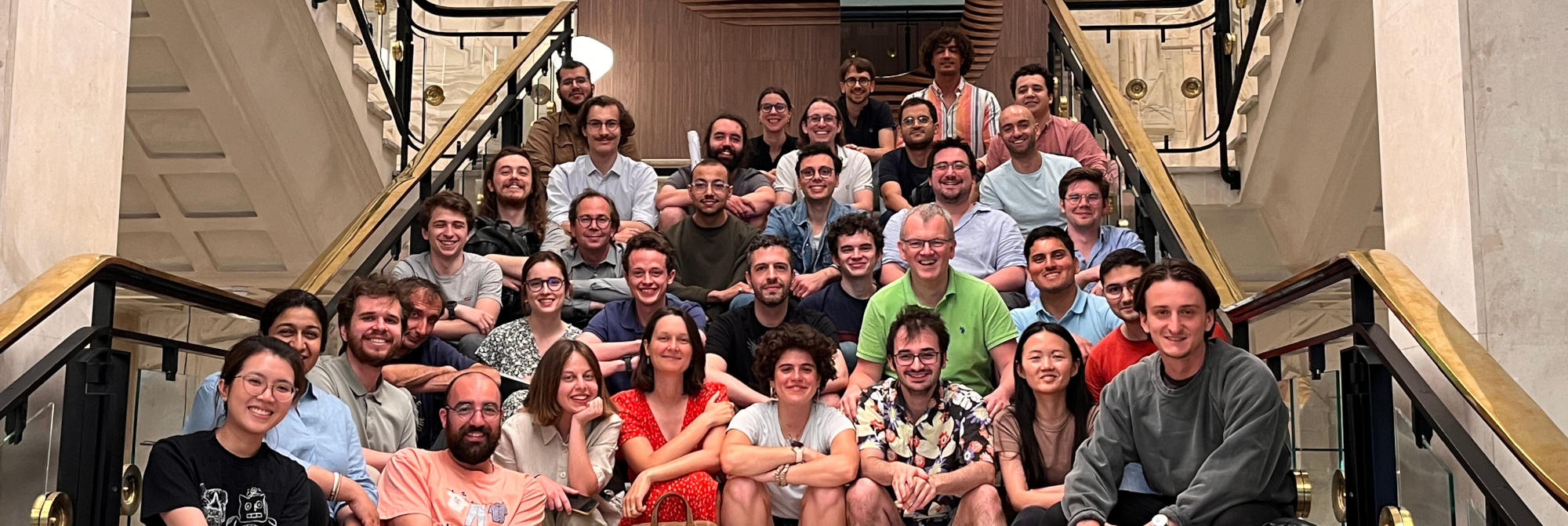
Presentation
The SIMPAS team is part of the Centre de Mathématiques Appliquées within the École polytechnique.
The team brings together researchers from CMAP specializing in the broad area of randomness, in its widest sense. This includes data science, encompassing machine learning and artificial intelligence, as well as probabilistic modeling, such as simulation and numerical probability. Their work spans a wide spectrum within these fields, ranging from the theoretical foundations of algorithms to methodological developments and the efficient implementation of numerical schemes.
Research themes
-
Machine Learning and Artificial Intelligence: High-dimensional learning, neural networks, deep learning, adaptive control and model-free stochastic control, weakly supervised learning, stochastic optimization, reinforcement learning, generative models.
-
Statistical Learning: Empirical processes, random forests, kernel methods, missing data, principal and functional component analysis, sparse estimation, federated learning, transfer learning.
-
Image and Signal Processing: Multi-scale analysis, unsupervised classification, deep learning.
-
Bayesian Methods: Bayesian inference, Bayesian asymptotic statistics, Bayesian networks.
-
Statistical Modeling for Life Sciences: Model estimation, validation, and selection, mixed-effects models, pharmacokinetics.
-
Markov Processes and Markov Chains: Numerical approximation of non-linear dynamics (control, mean-field), dynamic programming equations, inference for continuous-time processes, hidden Markov models.
-
Uncertainty Quantification: Identification and propagation of uncertainties in numerical codes, intrusive and non-intrusive methods, chaos decomposition, Gaussian processes, metamodeling and response surface construction, design of numerical experiments, sensitivity analysis, robust optimization, risk analysis.
-
Stochastic Simulation: Particle methods, Markov Chain Monte Carlo (MCMC), rare events, stochastic algorithms, bandits, Monte Carlo regression, stochastic optimization, parallel computing.
-
Generative Models in AI: Diffusion models, variational autoencoders, normalizing flows, energy-based models, links with optimal transport.
-
Mathematical Statistics: Non-parametric estimation, model selection, classification, dimension reduction, robust statistics.